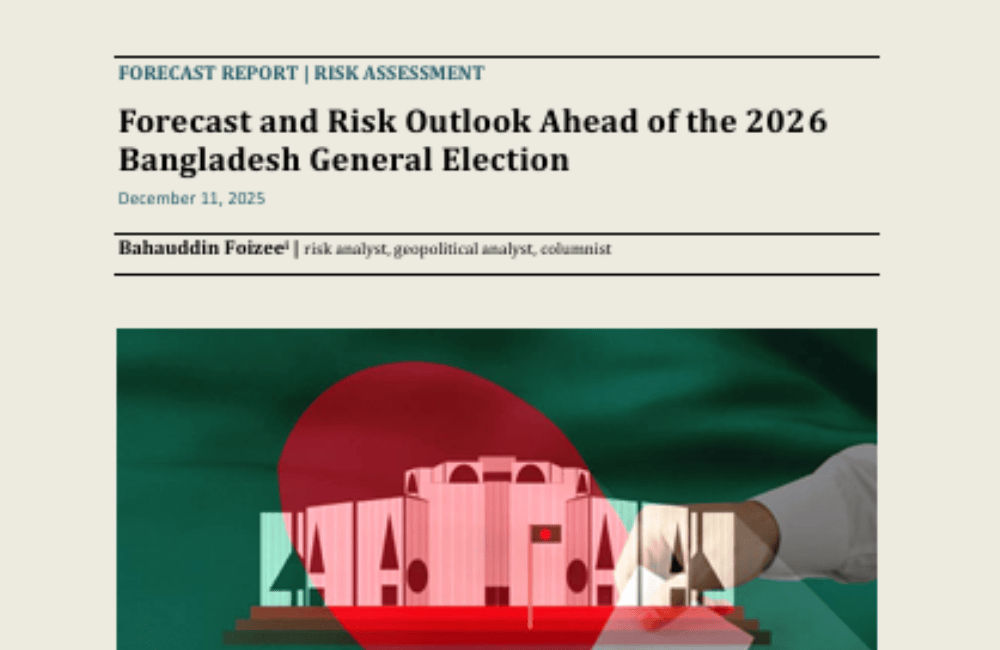
Forecast Report | PDF Document
Document Overview:
| Analyst | Bahauddin Foizee |
The Forecast Report, titled Forecast and Risk Outlook Ahead of the 2026 Bangladesh General Election, dated December 11, 2025, presents a risk-oriented assessment of Bangladesh’s political and security environment ahead of the parliamentary election and July Charter referendum scheduled for February 12, 2026. Anchored in the country’s post-2024 political transition, the report examines how unresolved questions of electoral legitimacy, political exclusion, competition among opposition parties, and the conduct of security forces could shape the stability of the electoral process.
Rather than treating the election as a routine transfer of power, the report frames the contest as a broader test of institutional credibility, political reconciliation, and the future distribution of authority in Bangladesh.
A central strength of the Forecast Report is its emphasis on the relationship between electoral participation and political legitimacy. The exclusion of the Awami League is presented as a structural vulnerability that could sustain grievances among its supporters while generating competing interpretations of accountability and democratic inclusion. At the same time, the report recognizes that the transition has not eliminated political rivalry, with the Bangladesh Nationalist Party (BNP), Jamaat-e-Islami (JI) and National Citizen Party (NCP) competing to consolidate their positions in the emerging political order.
By examining these overlapping pressures, the analysis moves beyond the immediate question of whether voting can proceed peacefully and considers whether the resulting government will command sufficient public and political acceptance to govern effectively.
The report adopts a measured, scenario-based approach to forecasting potential instability. It identifies politically motivated demonstrations, localized clashes, and disputes over electoral procedures as the principal near-term risks, while treating sustained nationwide disorder as a credible but less certain escalation scenario.
The report’s assessment distinguishes between a managed but tense electoral transition, a more severe crisis involving widespread unrest and a contested election, and a less likely but plausible pathway toward stabilization through credible electoral administration and institutional reform. This approach allows the report to account for uncertainty without presenting a single outcome as inevitable. Its emphasis on escalation triggers, including major security incidents, disputed electoral decisions, and allegations of systematic bias, also provides a framework for understanding how localized confrontations could acquire wider political significance.
Another important feature of the Forecast Report is its treatment of security-sector conduct as both a stabilizing mechanism and a potential source of escalation. The deployment of military personnel alongside regular law enforcement may strengthen the interim government’s capacity to contain disturbances, but the report cautions that disproportionate force, perceived partisan enforcement, or mass arrests could deepen political grievances and undermine confidence in state institutions. This creates a central dilemma for the Yunus-led administration: maintaining public order while demonstrating impartiality and restraint.
By linking operational security measures to broader questions of political credibility, the report underscores that the effectiveness of the security response will depend not only on its capacity to prevent disruption but also on whether its conduct reinforces or weakens public confidence in the transition.
The proposed July Charter referendum adds a further layer of complexity to the electoral environment. Its provisions, intended to strengthen institutional checks and balances, judicial independence, and the autonomy of state institutions, could establish a foundation for a more accountable political system. However, disagreement over the adoption and implementation of these reforms could intensify competition over the future structure of political authority.
The report therefore treats constitutional reform as both an opportunity for institutional renewal and a potential source of post-election friction. Its analysis suggests that even a technically orderly election may fail to produce lasting stability if disputes over political participation, reform implementation, and the distribution of institutional power remain unresolved.
Beyond domestic politics, the Forecast Report considers the potential regional and economic consequences of prolonged instability. Bangladesh’s relations with India, its strategic position between India and China, and its continuing challenges along the Myanmar border are presented as areas where domestic political disruption could complicate existing diplomatic and security priorities. The report also identifies transport interruptions, commercial disruption, and uncertainty surrounding cross-border trade as potential consequences of sustained unrest. Importantly, it distinguishes the effects of geographically limited disturbances from those of a prolonged legitimacy crisis, avoiding the assumption that every episode of political violence would necessarily produce nationwide economic disruption or a fundamental realignment of Bangladesh’s foreign relations.
The report further strengthens its forward-looking orientation through a set of early-warning indicators and risk-mitigation recommendations. Political mobilization by Awami League supporters, competition between the BNP and Jamaat-e-Islami, the conduct of security forces, the credibility of the Election Commission, disputes surrounding the July Charter referendum, and disruptions to transport and commercial activity are identified as indicators requiring continued monitoring. The emphasis on combinations of indicators rather than isolated incidents is particularly relevant to assessing escalation, as deteriorating political trust, increasingly confrontational mobilization, and coercive security responses could reinforce one another.
The recommendations directed at the interim government, political parties, businesses, and international stakeholders also translate the report’s risk assessments into practical priorities, including transparent electoral procedures, proportionate security measures, political dialogue, contingency planning, and reliance on verified information.
The Forecast Report functions as a strategic early-warning assessment of Bangladesh’s pre-election environment, linking immediate security concerns to the longer-term challenges of political legitimacy and institutional reform. Its central judgment is that localized demonstrations and politically motivated clashes are more plausible than sustained nationwide disorder, although a major security incident or a widely disputed electoral outcome could increase the risk of broader escalation.
The report’s principal contribution lies in demonstrating how political exclusion, inter-party competition, and the state’s response to unrest may interact to shape the credibility of the electoral transition. It presents Bangladesh’s trajectory as uncertain rather than predetermined: a credible electoral process could create space for institutional reform and renewed public confidence, whereas a contested or coercive process could prolong political instability and complicate the country’s regional and economic outlook..