| Analyst | Bahauddin Foizee |
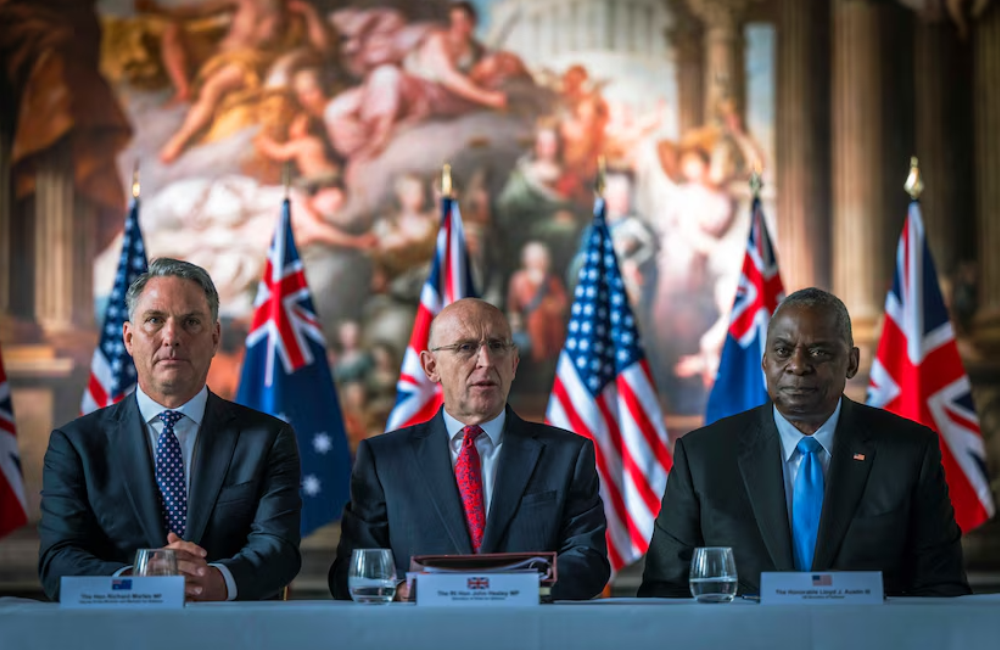
In a pivotal moment for the AUKUS security alliance, U.S. Secretary of Defense Lloyd J. Austin III has underscored the strategic importance of this trilateral partnership during his recent meeting in London with British Defense Secretary John Healey and Australian Defense Minister Richard Marles. Austin’s remarks highlight the growing military capabilities of Australia, particularly in the realm of nuclear-powered submarines, and reflect a broader commitment to deterrence in the increasingly complex geopolitical landscape of the Indo-Pacific region.
The meeting, which took place on September 26, came at a time of heightened tensions in Asia, particularly with China’s assertive military maneuvers. Austin’s emphasis on bolstering Australia’s military capabilities—especially the acquisition of conventionally armed, nuclear-powered submarines—marks a significant shift in defense strategy. The integration of Australian forces into nuclear training programs in the U.S. and U.K. illustrates a concerted effort to not only enhance regional deterrence but also to foster interoperability among allied forces.
The timeline Austin provided is ambitious. With a rotational presence of U.S. submarines expected by as early as 2027 and the goal of establishing Australia’s own nuclear-powered submarine capability in the early 2030s, the AUKUS alliance is clearly prioritizing rapid development and deployment of advanced military technologies. This is a clear signal not only of trust but of shared objectives among the three nations.
Furthermore, the AUKUS partnership is poised to push the boundaries of military innovation, focusing on cutting-edge technologies like artificial intelligence, cyber capabilities, and hypersonics. The inclusion of Japan in discussions about maritime autonomy, alongside potential contributions from Canada, South Korea, and New Zealand, suggests a widening circle of cooperation that could redefine security dynamics in the Indo-Pacific.
The recent easing of export control restrictions, particularly regarding the sale of U.S. Virginia-class submarines to Australia, is a crucial step in facilitating this cooperation. It reflects a recognition that traditional barriers to defense collaboration need to be reexamined in light of modern threats. The amendments to the International Traffic in Arms Regulations are indicative of a shift towards a more flexible and cooperative approach to defense procurement, allowing for faster and more efficient capability enhancement.
However, the expansion of AUKUS also raises questions about regional reactions. While the alliance is clearly designed to counterbalance China’s growing influence, it could also provoke a response from Beijing, potentially escalating tensions further. The focus on military capabilities and advanced technology might be seen as a threat, and the dynamics of regional security are likely to evolve in unpredictable ways.
In conclusion, AUKUS represents a bold step towards a more integrated and capable defense posture in the Indo-Pacific. As Secretary Austin noted, this is just the beginning for Australia’s nuclear-powered submarine program and the broader ambitions of the alliance. The next few years will be critical in determining how effectively these initiatives translate into enhanced security and stability in a region characterized by shifting alliances and increasing uncertainty. As the world watches closely, the implications of this partnership will resonate far beyond the shores of Australia, the U.K., and the U.S.




 Bahauddin Foizee