|Analyst|Nicholas Lovric|
The geopolitical tremors triggered by CIA Director William Burns’ warning about Iran potentially supplying ballistic missiles to Russia mark a pivotal inflection point in the post-Cold War security order. While the Biden administration continues to reinforce support for Ukraine, the implications of a deepening Iran-Russia military alliance represent a broader and more volatile threat—one that spans continents and strategic fault lines.
This development—described by Burns as a “dramatic escalation”—is not merely a tactical evolution in Russia’s war against Ukraine. It is a strategic signal of a shifting global power dynamic, where rogue states increasingly find in each other the means to circumvent international norms and erode Western deterrence. Burns’ framing of the partnership as a “two-way street” is especially chilling. It reflects a convergence where not only weaponry changes hands, but operational knowledge and technology cross-pollinate to form a more sophisticated and dangerous adversary bloc.
Reports suggesting that Iran has already sent ballistic missiles to Russia—despite explicit U.S. and European warnings—underscore the limits of Western leverage. If these reports are accurate, it exposes the fragility of deterrence mechanisms and the declining fear of Western reprisal among revisionist states. The idea that Iranian-manufactured missiles could soon be raining down on Ukrainian cities, powered by Russian targeting and logistics capabilities, paints a grim picture of how quickly the war could escalate—and spread.
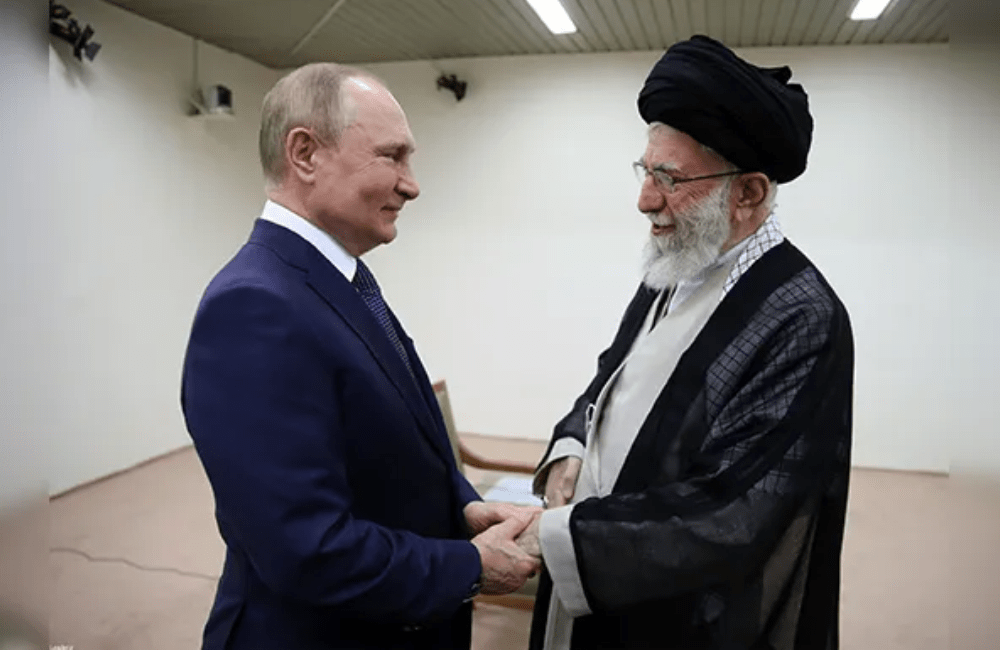
But the military threat is only one layer of this alliance. The broader significance lies in the geopolitical symbolism of Tehran and Moscow standing shoulder to shoulder. These two regimes—each long isolated and sanctioned by the West—have found in each other not only economic and military utility, but ideological kinship. They are united in their hostility to the liberal international order and in their willingness to test its red lines.
The consequences ripple far beyond Ukraine. Burns and MI6 head Richard Moore were right to link these developments to wider regional dynamics. A stronger Iran, emboldened by Russian backing, could double down on its destabilizing influence in Syria, Iraq, and Yemen. Moreover, this axis challenges U.S. authority in the Middle East at a time when Washington is struggling to balance its commitments in Europe and Asia. In this context, the potential normalization of relations between Israel and Saudi Arabia becomes more than a diplomatic breakthrough—it becomes a strategic necessity, forming a counterbalance to Iranian adventurism.
What we are witnessing is the gradual crystallization of an alternative power structure—one less beholden to Western norms, more comfortable with transactional authoritarianism, and increasingly willing to use force to achieve its aims. This development is not unprecedented; echoes of Cold War proxy dynamics are evident. But the new configuration is more fluid, less ideologically rigid, and thus harder to predict or contain.
Russia’s desperation—manifest in sabotage and criminal tactics across Europe, as described by Burns and Moore—is a further warning sign. It suggests that Moscow is prepared to take risks it once avoided, calculating that Western unity can be frayed by time, cost, and domestic fatigue. If Iran follows suit, empowered by its newfound partner, the result could be a cascading series of provocations and responses that push the world toward a broader conflict.
Against this backdrop, the West must not be reactive. Strategic ambiguity, half-measures, and incremental responses will only invite further aggression. The warnings from Burns and Moore must serve as a catalyst for a cohesive strategy—military, diplomatic, and informational—that clearly outlines the costs of continued escalation by Iran and Russia.
This also requires engaging the public. The complexity of this emerging alliance demands a renewed discourse around security, deterrence, and the defense of international norms. Western democracies cannot afford complacency. Policymakers must connect the dots for their citizens: a missile strike in Ukraine today may be tied to a drone shipment from Tehran yesterday and could affect NATO security tomorrow.
In the final analysis, the Iran-Russia partnership is not just a wartime convenience; it is a signal of long-term alignment that threatens the foundations of global stability. If left unchecked, it could embolden not only its core members but also other authoritarian states seeking to exploit divisions in the West. The stakes are immense—and growing.
Now is the time for clarity, coordination, and conviction. The rules-based international order will not defend itself. The West must show that it still has the will and the tools to meet this moment.




 Bahauddin Foizee