|Analyst|Bahauddin Foizee|
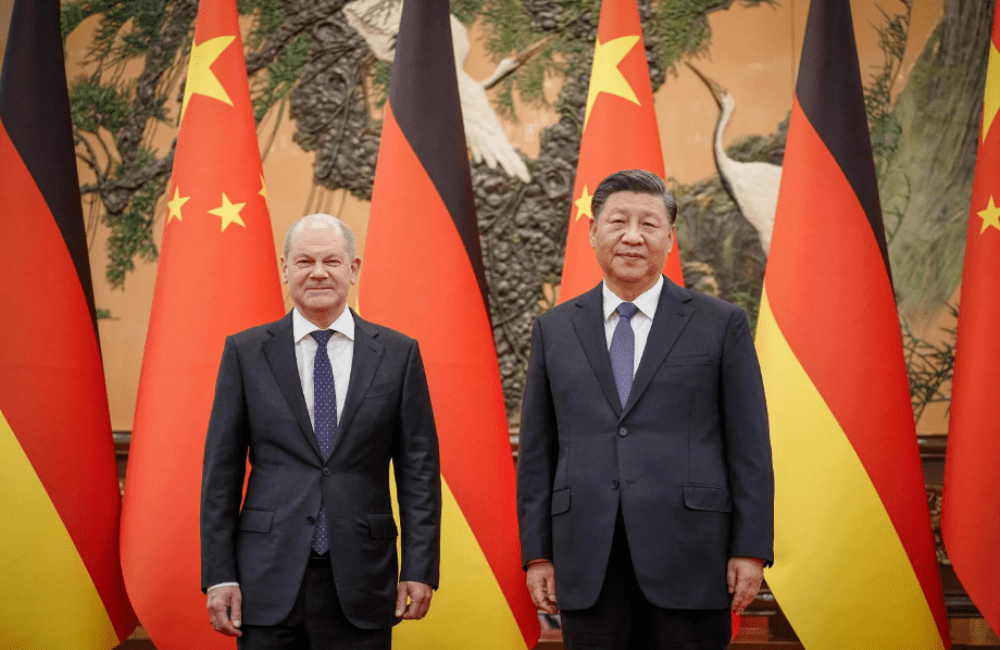
Chancellor Olaf Scholz’s second visit to China in April 2024 highlights a pivotal moment for Germany, reflecting the country’s struggle to balance robust trade ties with rising geopolitical concerns. As the European Union becomes increasingly wary of over-reliance on China—fueled by fears of economic dependency and competitive imbalances—Germany stands at a crossroads, attempting to uphold its substantial trading relationship while recalibrating its strategic outlook.
Trade figures underscore the depth of this relationship: in 2023, Germany’s trade with China reached an impressive €253.1 billion, maintaining China’s status as Germany’s top trading partner for the eighth year running. Yet, beneath this impressive figure lies a growing disquiet. The 30% drop in German foreign direct investment (FDI) in China during the first three quarters of 2023 reveals a shift in corporate sentiment, reflecting heightened awareness of risks tied to the Chinese market. This reassessment is particularly acute in sectors like automotive, which has historically depended on critical materials like magnesium from China.
The phenomenon of “de-risking” is increasingly becoming a focal point in German economic strategy. Scholz’s visit underscores the dual objectives of nurturing trade while seeking to mitigate dependency. Germany’s “Strategy on China” aims to navigate this complex landscape, promoting trade engagement while cautiously recalibrating its reliance on a market that poses significant regulatory and competitive challenges. The reduction in investment guarantees from €745.9 million in 2022 to just €71 million in 2023 exemplifies this cautious pivot, illustrating the government’s acknowledgment of the rising risks associated with investment in China.
Despite these challenges, major corporations such as BASF, Volkswagen, and Siemens continue to invest significantly in China, demonstrating the paradox of Germany’s current economic stance. BASF’s planned €10 billion chemical complex in Zhanjiang, expected to be operational by 2030, illustrates the persistent allure of China’s expansive consumer market, even as the discourse around reducing dependency intensifies.
In response to these dynamics, Southeast Asia has emerged as a potential alternative for German companies. Approximately 60% of businesses operating in China are exploring options to enhance supply chain resilience, looking towards Southeast Asia as a new frontier. High-ranking German officials, including Foreign Minister Annalena Baerbock and President Frank-Walter Steinmeier, have actively engaged with Southeast Asian nations, reflecting a strategic pivot in Germany’s economic partnerships.
However, the transition to Southeast Asia is fraught with challenges. While the region offers lower labor costs and growth potential, it also presents significant hurdles, such as reliance on Chinese imports and the overwhelming dominance of Chinese manufacturing. The costs and inefficiencies associated with relocating operations may deter some companies from making this shift.
Germany’s path forward is complex and necessitates a delicate balance between economic interests and geopolitical realities. Scholz’s visit illustrates that while diversifying partnerships is essential, many economic pathways for Germany still lead back to China. The intricate web of decisions required to navigate this landscape will shape not only Germany’s economic future but also its role in an increasingly polarized global environment.
As geopolitical tensions continue to rise and alliances shift, Germany must remain agile, identifying new opportunities while safeguarding its core interests. The balancing act between engagement and caution will define Germany’s economic strategy in the coming years, demanding nuanced navigation to ensure resilience in a rapidly evolving world.




 Bahauddin Foizee