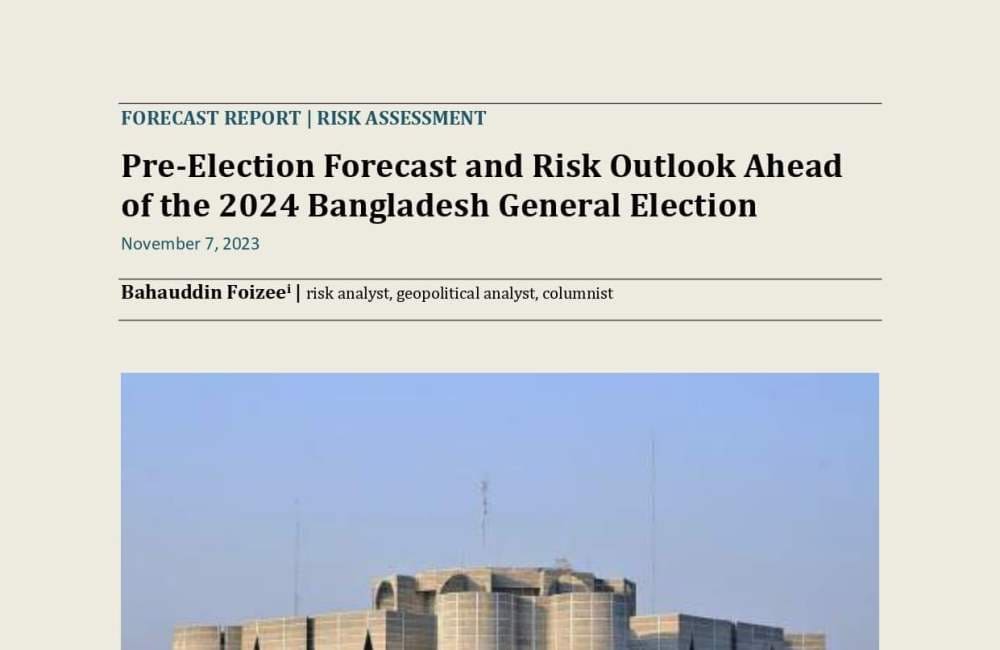
Forecast Report | PDF Document
Document Overview:
| Analyst | Bahauddin Foizee |
The Forecast Report (Risk Outlook) on Bangladesh’s upcoming election in early 2024 is structured as a risk-oriented pre-election forecast, anchored firmly in conditions observable as of early November 2023. Alongside factors like institutional imbalance, opposition marginalization and securitized governance, the report also adds speculative detail, which strengthens its credibility as a forward-looking document.
A central strength of the Forecast Report is its measured tone. Rather than predicting specific incidents, it assesses likelihoods (high, moderate, low) across different phases of the electoral timeline. This allows the analysis to remain resilient to uncertainty while still offering clear warning signals, particularly regarding pre-election violence and post-election legitimacy challenges.
The Forecast Report, also a Risk Outlook, places deliberate emphasis on process over personalities. While political actors are named, the forecast focuses more on systemic dynamics—such as the absence of a caretaker government, the role of security forces and the constrained electoral space—thereby avoiding over-personalization and maintaining analytical distance.
Foreign reactions are treated as predictable policy patterns rather than moral endorsements or condemnations. By distinguishing between Western democratic conditionality and regional stability-driven engagement, the Forecast Report clarifies how Bangladesh’s post-election diplomatic environment is likely to fragment without overstating immediate economic or sanctions-related fallout.
Notably, the Forecast Report treats post-election unrest as latent rather than immediate, highlighting the risk of deferred instability. This is an important analytical choice, suggesting that the most serious consequences of the election may manifest over time through social disengagement rather than through immediate mass protests.
Overall, the Forecast Report functions effectively as a strategic early-warning document. Its value lies less in predicting exact outcomes and more in mapping the pressure points where political legitimacy, public trust and international credibility are most likely to erode if existing trajectories remain unchanged.




 Bahauddin Foizee