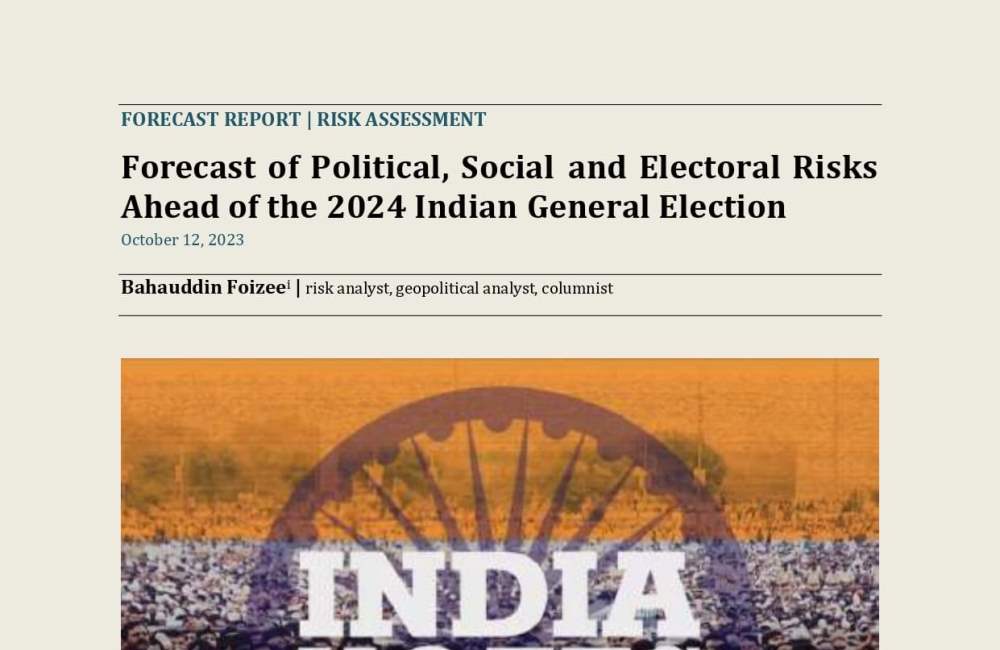
Forecast Report | PDF Document
Document Overview:
| Analyst | Bahauddin Foizee |
As India approaches its largest-ever general election in 2024, the political environment is shaping up to be both fiercely competitive and delicately balanced, with the potential for localized instability and heightened social tensions. For nearly a decade, the Bharatiya Janata Party (BJP) under Prime Minister Narendra Modi has enjoyed unprecedented dominance. However, the 2024 contest signals a clear shift in the political calculus, as opposition forces coalesce for the first time in decades.
The formation of the INDIA coalition, encompassing the Congress Party, Trinamool Congress, DMK, Samajwadi Party, and several other regional entities, represents a strategic realignment of political power. This unprecedented unity poses a tangible challenge to the BJP, particularly in high-stakes states such as Uttar Pradesh, Bihar, and West Bengal, where the competition is expected to be most intense. In these regions, historical party rivalries and deep-rooted caste and community dynamics have the potential to turn each constituency into a battleground, influencing both local outcomes and the national tally.
Economic factors compound this political tension. Rising inflation, persistent unemployment, and rural distress are emerging as central voter concerns, providing fertile ground for the opposition to challenge the incumbent government. While the BJP can point to infrastructure projects, international diplomatic achievements, and broader developmental initiatives as accomplishments, the lived realities of citizens—particularly in rural and semi-urban regions—may temper the party’s narrative. Young voters, numbering in the hundreds of millions, are particularly sensitive to issues of employment and opportunity, adding an additional layer of unpredictability to voter behavior.
Socially, the country remains deeply polarized. Religious, caste, and regional identities continue to shape political alliances and voter mobilization. The rise of social media and digital campaigning further amplifies this polarization, with the spread of misinformation and manipulated content capable of triggering unrest or influencing voter perception. In hotspots such as Manipur, where ethnic tensions between the Meitei and Kuki communities persist, these dynamics could translate into more acute operational risks, including the disruption of polling or threats to voter safety.
The risk of election-related violence, though mostly localized rather than nationwide, cannot be ignored. West Bengal and Uttar Pradesh stand out as potential flashpoints due to intense political rivalry and pre-existing social tensions. Manipur’s electoral environment, already strained by ethnic conflict, poses the highest operational risk, with armed disruption and intimidation likely to impact the conduct of voting. Minor clashes and campaign-related unrest are also forecasted in Bihar, Maharashtra, and Telangana, highlighting the patchwork nature of volatility across the country.
Operationally, India’s Election Commission is expected to deploy unprecedented security measures, including the pre-positioning of paramilitary forces, rapid-response teams, and extensive monitoring of polling stations. These measures, while likely to contain widespread disruption, underscore the high stakes and complex logistics of managing an election of this scale.
In sum, the 2024 general election is shaping up to be a knife-edge contest. BJP’s historical dominance may be challenged in critical constituencies, the opposition’s newfound cohesion introduces uncertainty, and the socioeconomic and social pressures provide a volatile backdrop. While national-level disruption remains unlikely, the combination of political, economic, and regional risks positions this election as one of the most competitive and unpredictable in modern Indian history.
For analysts, policymakers, and security planners, the 2024 election is not merely a contest for seats; it is a stress test for India’s democratic resilience, highlighting both the strengths of a robust electoral system and the vulnerabilities inherent in managing a diverse, polarized, and rapidly evolving society. Close monitoring, strategic mitigation of hotspots, and transparent communication will be essential to navigate this unprecedented electoral landscape.




 Bahauddin Foizee