| Analyst | Bahauddin Foizee |
In recent years, the geopolitical dynamics in the Asia-Pacific have been shifting, with China and Russia emerging as increasingly assertive military players in the region. The two countries, long united in a strategic partnership, have increasingly engaged in joint military activities that seem designed to challenge the interests of the U.S. and its key allies, particularly Japan and South Korea. As these two nations prepare their own defenses, the balance of power in the region grows ever more precarious.
Russia’s Growing Military Role in the Asia-Pacific
Historically, Russia’s influence in the Asia-Pacific was limited, especially following the collapse of the Soviet Union. Its military involvement was mainly confined to arms deals with a few countries, including India. However, in recent years, Moscow has dramatically ramped up its presence, becoming the region’s largest arms exporter. Over 60% of Russia’s total arms exports now go to South and Southeast Asia, signaling a significant shift in its regional influence.
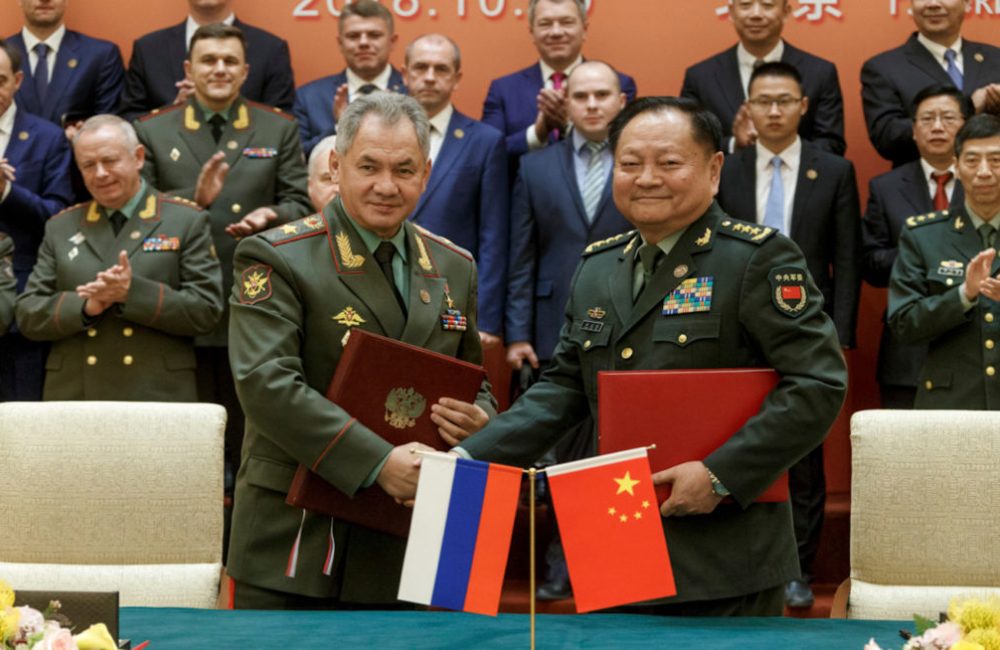
This military buildup is closely tied to Russia’s deepening partnership with China. As Moscow seeks to extend its reach across the Pacific, it is clear that China has played a key role in enabling this military adventurism. From joint military exercises to coordinated air patrols, Russia’s actions are increasingly aligned with China’s growing ambitions in the region.
China’s Expanding Military and Economic Footprint
While Russia’s influence has been on the rise, China’s presence in the Asia-Pacific is more firmly entrenched. Beijing has long had substantial economic ties across the region, and it has made significant strides in building up its military capabilities as well. The People’s Liberation Army (PLA) now dominates regional waters, including the contested South China Sea, and its military presence continues to grow. China has not only invested in infrastructure projects but has also become a major supplier of military equipment to countries throughout South and Southeast Asia.
This combination of economic power and military might gives China a commanding position in the region. Yet, as its influence expands, it has increasingly engaged in military operations that challenge regional stability, often in concert with Russia.
Joint Sino-Russian Military Operations: A New Normal?
The most striking example of this growing military cooperation between China and Russia came just months ago when the two nations conducted their first-ever joint long-range air patrols over the East China Sea and the Sea of Japan. Their warplanes reportedly entered the airspace of both Japan and South Korea, causing a sharp response from the two countries. According to experts like Dmitri Trenin and Artyom Lukin, this is just the beginning—more frequent and assertive joint military operations are expected in the future.
This collaboration is not entirely new, though. In 2018, Russia’s massive “Vostok” military exercises saw over 300,000 troops participate, with roughly 3,500 Chinese soldiers taking part. The exercises, held in Russia’s Far East, were widely seen as a show of force aimed at asserting control over the Asia-Pacific region. Similarly, in 2016, Russian and Chinese warships conducted maneuvers near the disputed Diaoyu/Senkaku Islands in the East China Sea, leading to concerns that these actions were coordinated.
Together, these moves signal that China and Russia are not just testing the waters—they are setting the stage for a long-term strategic presence in the Asia-Pacific, one that is increasingly difficult for regional powers to ignore.
Japan and South Korea: Strengthening Defenses
In response to these growing military provocations, both Japan and South Korea have been taking steps to bolster their military readiness. Japan, in particular, has developed a robust defense strategy over the years, aided by its alliance with the U.S., while South Korea has similarly strengthened its own capabilities. Both countries have also become more proactive in intercepting Chinese and Russian military incursions.
During the aforementioned joint air patrol, both Japan and South Korea were quick to scramble fighter jets in response to Chinese and Russian warplanes encroaching on their airspace. South Korean jets even fired warning shots at Russian bombers during the encounter. These actions reflect a growing determination by Japan and South Korea to protect their air and maritime boundaries from increasingly bold military actions by China and Russia.
A Trilateral Shield Against Military Expansion
As China and Russia continue to push the envelope with their military adventures, the trilateral cooperation between the U.S., Japan, and South Korea is proving to be a crucial counterbalance. Much like NATO’s role in Europe against Russian aggression, the U.S.-Japan-South Korea alliance has become a key deterrent to Sino-Russian military expansion in the Asia-Pacific. The strengthening of this partnership, coupled with increased military cooperation, is essential for maintaining regional stability in the face of a growing military threat from Beijing and Moscow.
In conclusion, the Asia-Pacific is entering a new era of military tensions, with China and Russia working together to project power in ways that challenge the status quo. For Japan, South Korea, and their American allies, the need for a strong, unified response has never been more urgent. As the region becomes a focal point for great power competition, the future of peace and security in the Asia-Pacific will depend largely on how well these nations can adapt to the evolving military landscape.




 Bahauddin Foizee